The Role of Extra-Articular Augmentation Procedures in ACL Surgery: Iliotibial Band Tenodesis
Anterior cruciate ligament (ACL) reconstruction remains one of the most common and successful procedures in sports medicine. However, persistent rotational instability, particularly in high-risk athletes and patients with ligamentous laxity or meniscal injury, has driven interest in adjunctive procedures that address the anterolateral complex of the knee. Iliotibial band (ITB) tenodesis, often referred to within the broader context of lateral extra-articular tenodesis (LET), has emerged as a valuable tool in selected patients.
Why Consider Extra-Articular Augmentation?
While isolated ACL reconstruction effectively restores anterior tibial stability, it does not always fully control rotational laxity, a key factor in pivoting sports injuries and recurrent instability. Residual pivot shift (rotational instability) has been associated with poorer functional outcomes and increased risk of graft failure.
Extra-articular procedures such as ITB tenodesis are designed to enhance control of anterolateral rotational laxity by reinforcing the lateral knee structures. These procedures aim to:
- Reduce rotational instability, particularly pivot shift
- Lower graft strain during early healing
- Potentially decrease re-rupture rates in high-risk populations
- Limit knee hyperextension in early graft healing phases
Current Evidence & Indications
Evidence from recent clinical cohorts and biomechanical studies supports the selective use of ITB tenodesis in conjunction with ACL reconstruction:
Indications Where Augmentation May Be Beneficial
- High-grade pivot shift on clinical examination
- Knee hyperextension and Generalized ligamentous laxity (e.g., hypermobility)
- Elite or pivoting athletes seeking maximal stability, including pediatric patients
- Revision ACL reconstruction, especially after prior graft failure
- Concomitant anterolateral complex injury identified intraoperatively
Outcomes Data
- Recent comparative studies suggest that combined ACL reconstruction with lateral extra-articular augmentation may reduce the rate of residual rotational laxity compared with isolated ACL reconstruction.
- Biomechanical research demonstrates that augmentations such as ITB tenodesis can offload the ACL graft and restore native knee kinematics more effectively in rotational planes.
- Some evidence points toward lower revision rates in high-risk cohorts when augmentation is used, though long-term randomized data are still evolving.
Importantly, appropriate patient selection is critical. Not all ACL injuries require lateral augmentation, and indiscriminate use may expose patients to unnecessary procedures without clear benefit.
Surgical Technique Overview
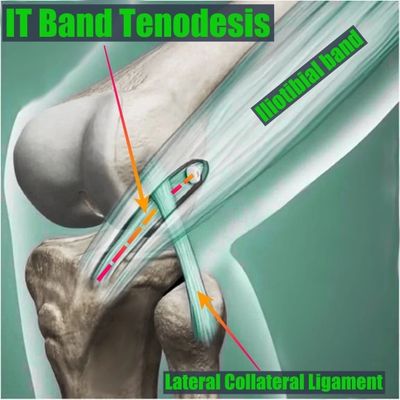
ITB tenodesis involves harvesting a strip of the iliotibial band, directing it underneath the lateral collateral ligament and securing it to the lateral femur to reinforce the anterolateral structures. The procedure is performed at the same time as the ACL reconstruction through a separate incision on the side of the knee. It does significantly increase operative time or complexity when executed by surgeons experienced in lateral knee anatomy.
Recovery & Rehabilitation
A common concern among patients and clinicians is whether adding an extra-articular procedure prolongs recovery or increases postoperative pain. Based on my clinical experience:
- Recovery timelines after ACL reconstruction with ITB tenodesis are comparable to isolated ACL reconstruction.
- Return to weight-bearing and functional milestones follow standard ACL protocols, tailored to individual progress.
- Postoperative pain levels are not significantly different in most patients, and standard multimodal analgesia remains effective.
It is crucial, however, to communicate that recovery is individualized and compliance with physical therapy protocols plays a significant role in outcomes.
Conclusion
Iliotibial band tenodesis and other extra-articular augmentation procedures serve as valuable additions to ACL surgery for appropriately selected patients. When indicated, these techniques can improve control of rotational instability without increasing recovery timelines or postoperative pain. As with all surgical decisions, a personalized assessment of risk factors, functional goals, and intraoperative findings should guide whether augmentation is employed.
For more insights into surgical techniques, rehabilitation protocols, or to discuss whether extra-articular augmentation may benefit you or your patients, please contact our clinic.

ACL Surgery in Oregon
Dr. Daniel Elkin is a leading Orthopedic Surgeon performing ACL Surgery in the Willamette Valley. He specializes in complex knee reconstruction and knee arthroscopy and is conveniently located in Salem, Oregon.
